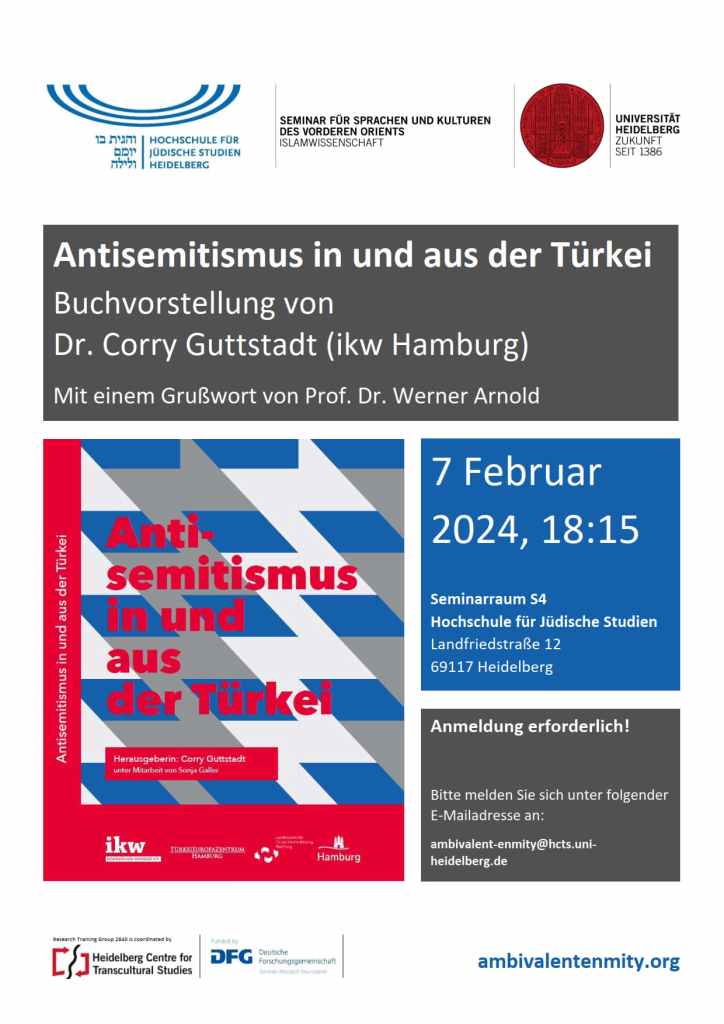
Antisemitism in and from Turkey, February 7, 2024, 18:15 p.m.

We look forward to Dr. Corry Guttstadt presenting the recently published edition “Antisemitismus in und aus der Türkei” on February 7 at 18:15 p.m. The event will take place in Room S4 at the Hochschule für Jüdische Studien. Prof. Dr. Werner Arnold will offer a short opening address.

The event will be held in German.

Please register under the following e-mail address: ambivalent-enmity@hcts.uni-heidelberg.de

The book deals with the broad and long history of antisemitism in Turkey, tracing it back to the late Ottoman Empire. The main focus of the book is placed on recent developments both in Turkey and in Germany and contains many insights offered by scientists and activists in the field.

Corry Guttstadt is a renowned turcologist and historian. Her research is focused on the situation of minorities in Turkey, antisemitism and the history of Sephardic Jews. She is currently associated with the ikw Hamburg as well as a former Senior Fellow with the Vienna Wiesenthal Institute on Holocaust Studies and has led the Türkei-Europa-Zentrum in Hamburg.
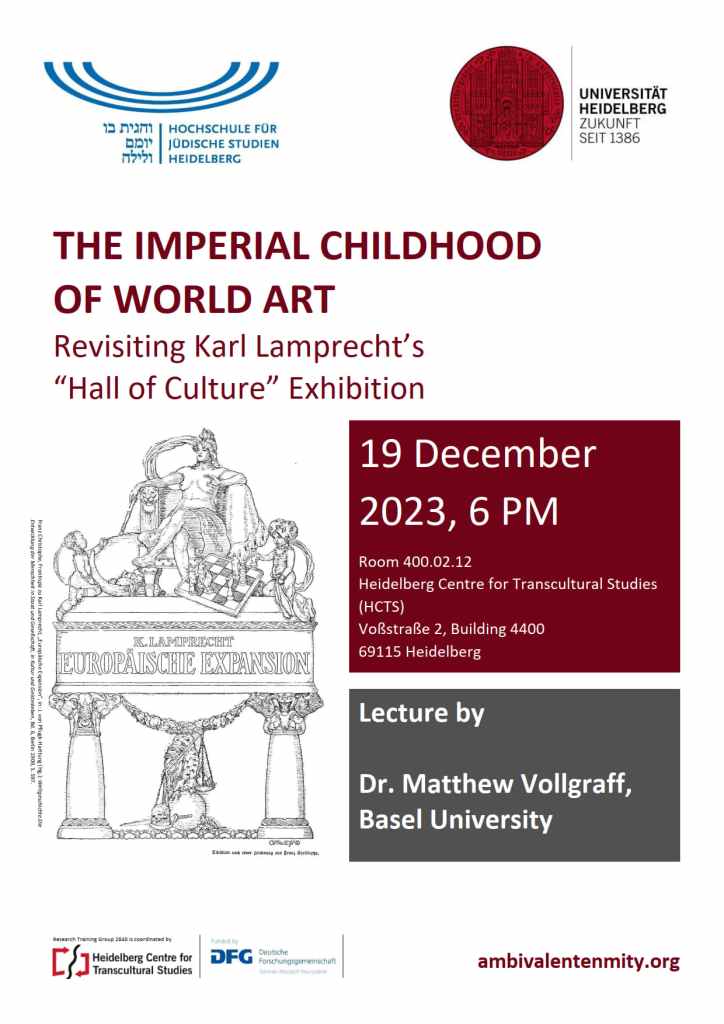
The Imperial Childhood of World Art: Revisiting Karl Lamprecht’s ‘Hall of Culture’ Exhibition”, December 19, 2023, 6 p.m.

We are delighted to welcome Dr. Matthew Vollgraff for a lecture on the topic of “The Imperial Childhood of World Art: Revisiting Karl Lamprecht’s ‘Hall of Culture’ Exhibition”. The event will take place on December 19 at 6 p.m. in Room 400.02.12 at the Heidelberg Centre for Transcultural Studies (Voßstr. 2, Building 4400, Second floor).

Matthew Vollgraff is a cultural historian who specializes in the science, politics, and visual culture of modern central Europe. He is a NOMIS fellow at the University of Basel, currently working on a new book project titled Migration as Method: Diffusionism and the Global Politics of the Deep Past, 1890–1960.

In the summer of 1914, just months before the outbreak of the First World War, the first comparative exhibition of ‘world art history’ opened at an international trade fair in Leipzig. Curated by the historian Karl Lamprecht, this ‘Hall of Culture’ was an unusually cosmopolitan affair that showcased photographic reproductions of artworks from ancient Greece, India, China, Japan, Mesoamerica, and prehistoric Europe. Yet all of this was organized around an unlikely core: Lamprecht’s prodigious collection of drawings by children from all over the globe, intended to serve as comparative indices of ethnic or national mental ‘development’. Taking this long-overlooked exhibition as its focus, this talk sites the origins of the discourse on ‘world art’ at the perilous convergence of universal history, child psychology and the imperial politics of the late Wilhelmine Empire. The 1914 exhibition was not only rooted in paternalistic colonial imaginaries but also in Lamprecht’s concrete policies for cultural imperialism abroad, which carried the covert support by the Foreign Office. Ultimately the forgotten history of the ‘Hall of Culture’ exhibition offers an alternative genealogy of global art history that emerges from the conflicted encounter between Enlightenment ideals and colonial relations.

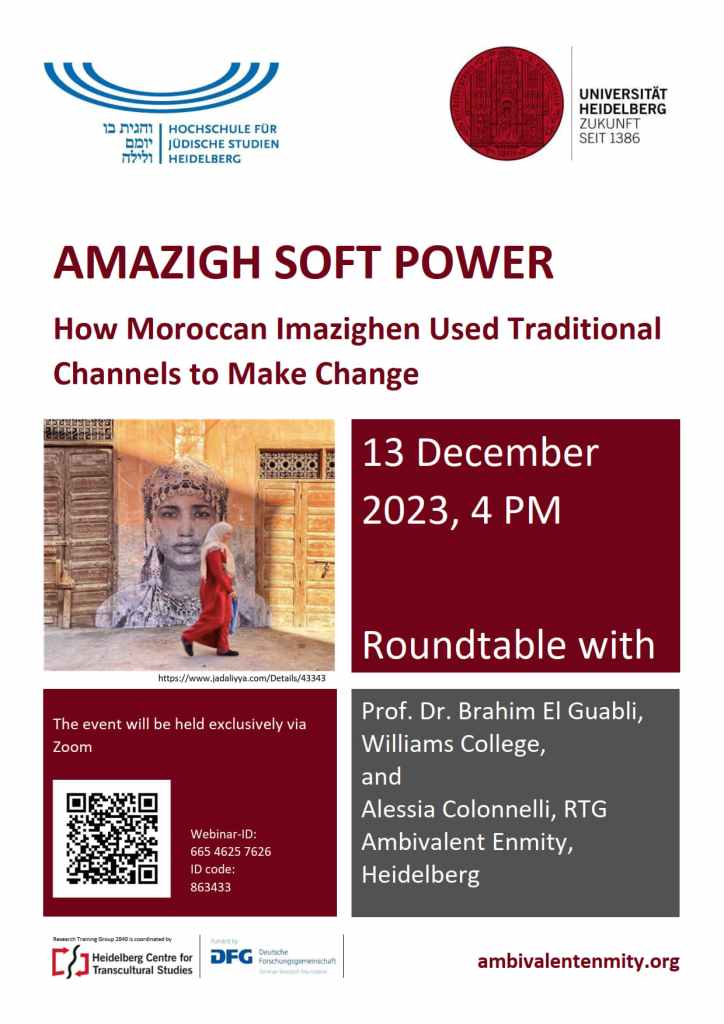
Amazigh Soft Power: How Moroccan Imazighen Used Traditional Channels to Make Change, December 13, 2023, 4 p.m.

We are delighted to welcome Prof. Dr. Brahim El Guabli and Alessia Colonnelli for a roundtable on the topic of “Amazigh Soft Power: How Moroccan Imazighen Used Traditional Channels to Make Change”.

The event will take place online on December 13 at 4 p.m. via Zoom.

Prof. Dr. Brahim El Guabli is an Associate Professor of Arabic Studies and Comparative Literature at Williams College, Massachusetts, USA. His research encompasses areas of language politics, indigeneity,  human rights, transitional justice, political violence, archive creation, memory studies, Amazigh/Berber literatures, and environmental humanities.

Professor El Guabli and our doctoral candidate Alessia Colonnelli will discuss the dynamics of conflict and bottom-up empowerment of the Amazigh identity movement in Morocco, by addressing the politics of identity in contemporary North Africa. Different patterns of conflict between the state and Moroccan indigenous Amazigh communities, as well as repertoires of soft power that Amazigh communities have resorted to exert pressure for a progressive recognition of Amazigh linguistic, cultural, and indigenous rights, will be discussed.